
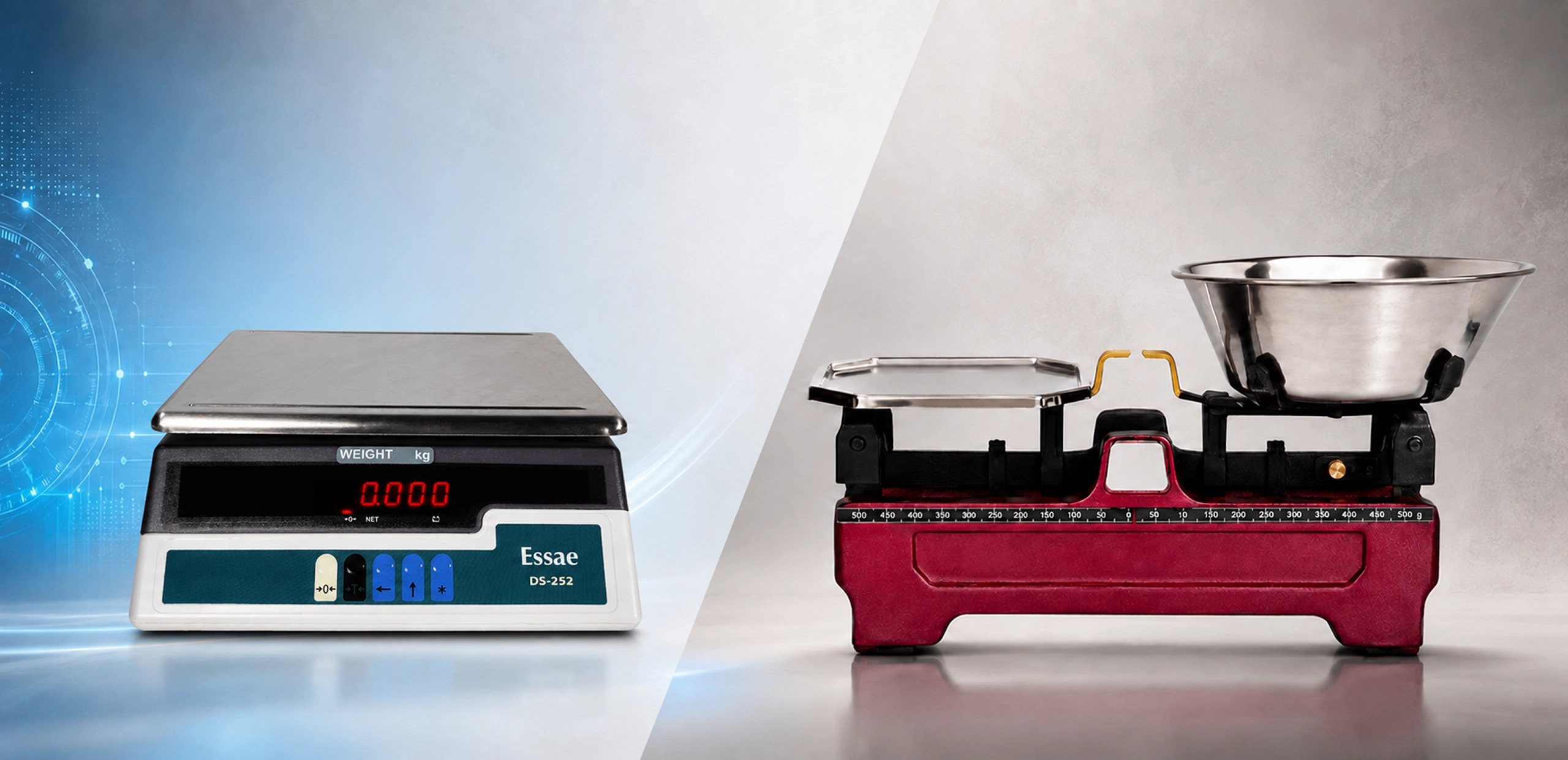
Weighing systems have played an important role in shops, factories, laboratories, and warehouses for decades. For a long time, mechanical scales were the standard choice. They used springs, levers, and pointer dials to show weight.
But with today’s need for faster work, repeat accuracy, and easy reading, digital weighing systems are becoming the preferred option. These electronic units rely on sensors, load cells, and microcontrollers that offer more stable and reliable results. Their compact build, extra functions, and user friendly displays make them suitable for almost every industry.
If your business requires accurate digital weighing, Essae supplies systems equipped with durable load cells, solid platforms, and reliable electronics to handle both light and heavy duty tasks.
Major benefits of switching to digital scales
Digital weighing systems offer several clear benefits over traditional mechanical scales. The following points highlight the main features and advantages that make digital scales more accurate, durable, and versatile in different industries.
Higher accuracy through advanced load cells
Mechanical scales depend on physical components such as springs and counterweights. Over time, these parts loosen, bend, or misalign due to frequent usage. This leads to reading errors, especially when dealing with small or delicate items.
Digital weighing systems use load cells, which are solid metal blocks fitted with strain gauges. When weight is placed on them, they produce electrical signals that are converted into digital numbers. Because there are fewer moving parts, the measurement remains stable even after thousands of uses. Industries like jewellery, labs, and electronics benefit the most from this consistent precision.
Easy to read digital displays
Pointed dials on mechanical scales can be hard to read from a distance, and even slight vibrations make the needle shake. This confuses and slows down the weighing process.
Digital scales come with LED or LCD displays. They provide clear numeric values with no guesswork. Backlit screens allow readings even in low light environments such as warehouses, cold storage rooms, or early morning market operations. The quick response time of the display helps workers move faster without repeated checking.
Stronger build quality and longer life
Mechanical systems rely heavily on springs and lever mechanisms. These components lose strength due to rust, load fatigue, or rough handling. Dust can also clog the internet parts, affecting movement.
Digital scales are built with sturdier frames, shock absorbing construction, and sealed electronic boards. Many industrial models have steel platforms, anti slip pads, and reinforced joints that withstand heavy usage. Because there are fewer friction based components, the internal structure does not wear out easily. This gives digital units a much longer operational life.
Ability to handle multiple weighing needs
Mechanical scales mostly provide one basic function: weight measurement. Digital systems offer multiple modes because of their internal microcontrollers.
Common features include:
- The task functions to reset the weight after placing containers.
- Piece counting for nuts, screws, and small items.
- Weight accumulation to total multiple items.
- Unit conversion between grams, kilograms, litres, and pieces.
In shops, warehouses, and manufacturing units, these functions simplify work and reduce dependency on extra tools or manual calculations.
Stable performance in different conditions
Changes in temperature, humidity, or load position can affect mechanical scale readings. Springs expand or contract, and dials shift slightly based on surrounding conditions.
Digital scales use temperature compensated load cells, seated circuits, and protective covers to maintain stability. Some advanced models even include overload protection to prevent damage if extra weight is placed accidentally. This steady performance is essential for industries like pharmaceuticals, food processing, and chemicals, where accuracy is critical for daily operations.
Faster calibration and low maintenance
Mechanical scales need manual calibration with weights, and adjusting the dial can be time consuming. This process often requires a trained technician, especially for larger or sensitive units.
In digital scales, calibration is simple and quicker. Many models support one touch calibration or offer internal calibration systems. Maintenance is minimal cleaning the platform and checking the battery or power supply is usually enough. Since there are no springs or mechanical gears to align, the scale stays accurate for longer periods without frequent servicing.
Better data handling and connectivity options
While mechanical scales cannot store or share data, digital systems offer parts and communication features that support today’s workflow requirements.
Some units come with:
- USB or RS-232 ports for connecting to printers, computers, or billing systems.
- Memory storage to save readings.
- Label printing options for retail and packaging.
- Direct connection to POS systems.
These capabilities help businesses maintain proper records, reduce manual writing errors, and speed up billing or production processes.
Compact and space saving designs
Mechanical scales often take up more room because of their large dials, bulky metal bodies, and extended weighing plates. They are also heavier, making them harder to move around a shop or factory.
Digital scales have a compact layout, slim platforms, and lightweight frames. They fit easily on counters, benches, or workstations. Some models are portable and run on rechargeable batteries, allowing outdoor use, ideal for field operations, delivery vehicles, and mobile shops.
Conclusion
The shift from mechanical to digital weighing systems is driven by real hardware improvements, better load cells, faster circuits, brighter displays, and durable metal frames. These features provide reliable readings, longer lifespan, and greater flexibility for modern industries. As businesses grow and require more accurate and efficient tools, digital weighing becomes a more practical choice.
Still wondering which weighing system can truly support your daily operations?
Essae’s advanced digital solutions are built to meet modern industrial and commercial standards, offering durability, accuracy, and reliable performance. Explore our product range to find the perfect model for your shop, factory, or laboratory and improve your weighing process today.


