
Milk is one of the most widely consumed foods globally, offering essential nutrients like protein, calcium, and fat. But despite its importance, milk adulteration continues to be a significant concern. From adding water to mixing in starch, urea, detergents, or preservatives, adulteration not only reduces nutritional value but can also pose serious health risks.
For dairy businesses, quality control is important, not just to protect consumers but also to ensure fair trade, consistent pricing, and product integrity.
Want to know how milk quality and safety are monitored in modern dairies? This blog will help you discover the key differences between milk analysers and adulteration milk analysers, and how Essae analysers make testing efficient and reliable.
What a milk analyser does?
A milk analyser focuses on measuring the natural composition of milk. Instead of looking for tampering, it determines what is inherently present in the milk, including fat, protein, SNF (solids-not-fat), lactose, and sometimes density. These parameters are necessary for dairies to calculate pricing, monitor quality, and ensure consistency across batches and suppliers.
Modern milk analysers often use ultrasonic sensing technology. Ultrasonic waves pass through a small sample of milk, and the way these waves behave provides insights into its composition. The machine reads the data and shows the results in numbers. These values help dairy operators answer questions like: “Does this milk meet our quality standards?” or “How should this batch be priced?”
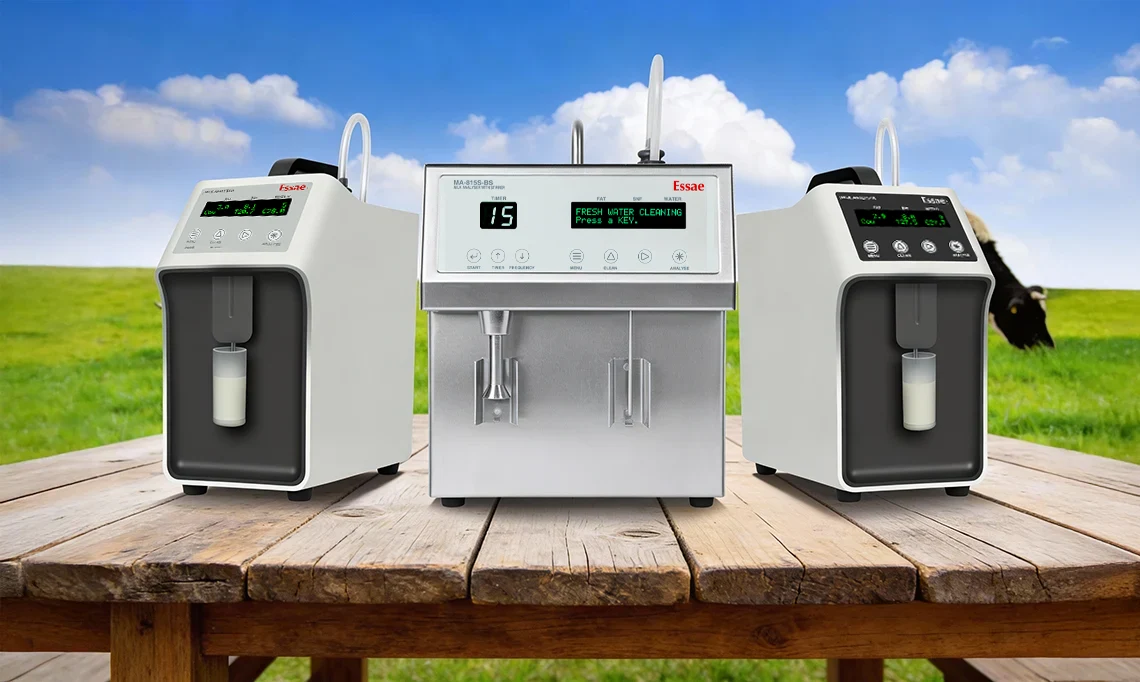
Products like the Essae MA‑815 and MA‑825 have become popular in Indian dairies for their speed and reliability. The MA‑815 measures fat, SNF, protein, lactose, and added water in under 40 seconds, making it suitable for high volume collection centers. The MA‑825, with its dual ultrasonic sensors, delivers even faster results while maintaining precision, making it ideal for busy dairies handling large milk volumes. Both models include easy to read displays and support data logging for record keeping and traceability. By providing quantitative data, milk analysers allow dairy operations to maintain consistency, monitor supplier performance, and ensure customers receive the nutritional value they expect.
What an adulteration milk analyser does?
While a milk analyser measures natural composition, an adulteration milk analyser serves a different purpose: it identifies whether milk has been tampered with. Its primary focus is detecting unwanted substances such as added water, starch, urea, detergents, neutralizers, and preservatives.
These analysers rely on conductivity, chemical, or optical sensing to identify abnormal behavior in the milk. When a sample deviates from expected natural patterns, the machine alerts operators, often with a simple pass/fail or warning signal. Unlike a milk analyser, it doesn’t provide detailed numeric values; its main job is to flag potential issues before milk enters processing or is accepted from suppliers.
Adulteration analysers are especially valuable at collection points, where fast decisions are critical. Identifying tampering early stops poor-quality milk from entering processing plants and protects both consumers and the supply chain.
Why are both machines necessary?
It’s a common misconception that only one analyser can do it all. Milk analysers and adulteration analysers complement each other rather than replace one another. A milk analyser provides a detailed view of composition, which is essential for pricing, payment, and quality tracking. However, it may not detect subtle adulteration, such as small amounts of water added carefully to maintain normal fat readings.
Conversely, an adulteration analyser can detect tampering but cannot tell you the exact fat, protein, and SNF content. That’s why many dairies and cooperatives use a two step approach, first screening milk with an adulteration analyser, then analysing the composition with the milk analyser. This workflow ensures both safety and accuracy in pricing and quality assessment.
|
Feature
|
Milk analyser
|
Adulteration milk analyser
|
|---|---|---|
|
Purpose |
Measures natural milk composition |
Detects foreign or unwanted substances |
|
Output |
Numeric values (fat%, SNF, protein) |
Alerts or pass/fail detection |
|
Sensor Type |
Ultrasonic |
Conductivity/Chemical/Optical |
|
Typical Use |
Pricing, grading, and quality monitoring |
Safety screening at intake points |
|
Data type |
Quantitative |
Qualitative |
|
Sample volume |
~25 ml |
~10–25 ml |
Practical tips for dairy operations
Using both analysers together provides a more complete picture of milk quality. Key practices include:
- Regular calibration to maintain accuracy.
- Keeping detailed records for traceability, audits, and supplier tracking.
- Combining simple visual checks (foam, flow, curdling on heating) with machine tests for early detection.
- Using machines like Essae IMA‑815 or MA‑825 for efficient, fast testing without compromising reliability.
Conclusion
Milk quality is about more than taste; it impacts nutrition, health, trust, and fair trade. Milk analysers like the Essae MA‑815 or MA‑825 provide accurate, quantitative insights into milk composition. Adulteration analysers ensure the milk hasn’t been tampered with before it enters the supply chain. Together, these tools allow dairies to maintain consistency, protect consumers, and support a fair and reliable market.
Understanding the difference between these machines and integrating them effectively into daily operations ensures that milk delivered to households is both safe and nutritionally valuable. For modern dairy operations, using both types of analysers is no longer optional; it’s an essential step in quality assurance and operational efficiency.


