
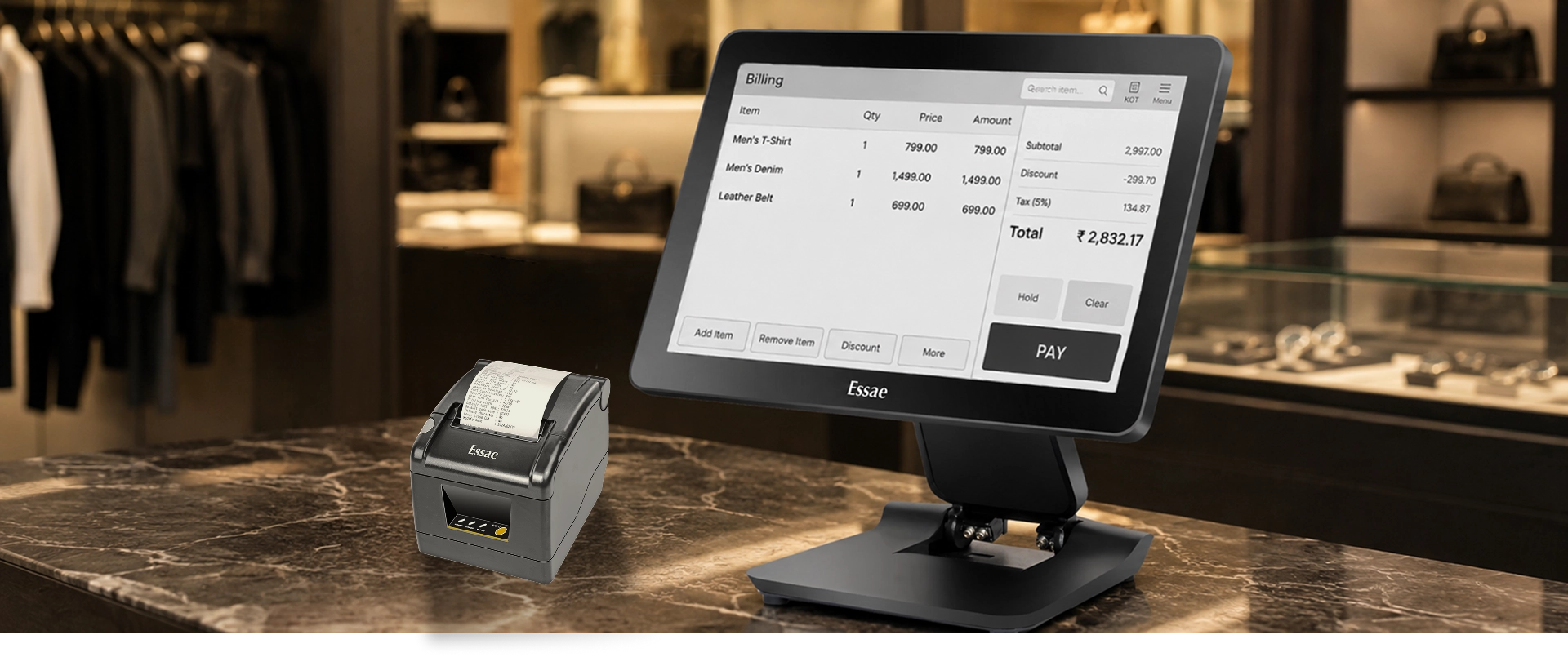
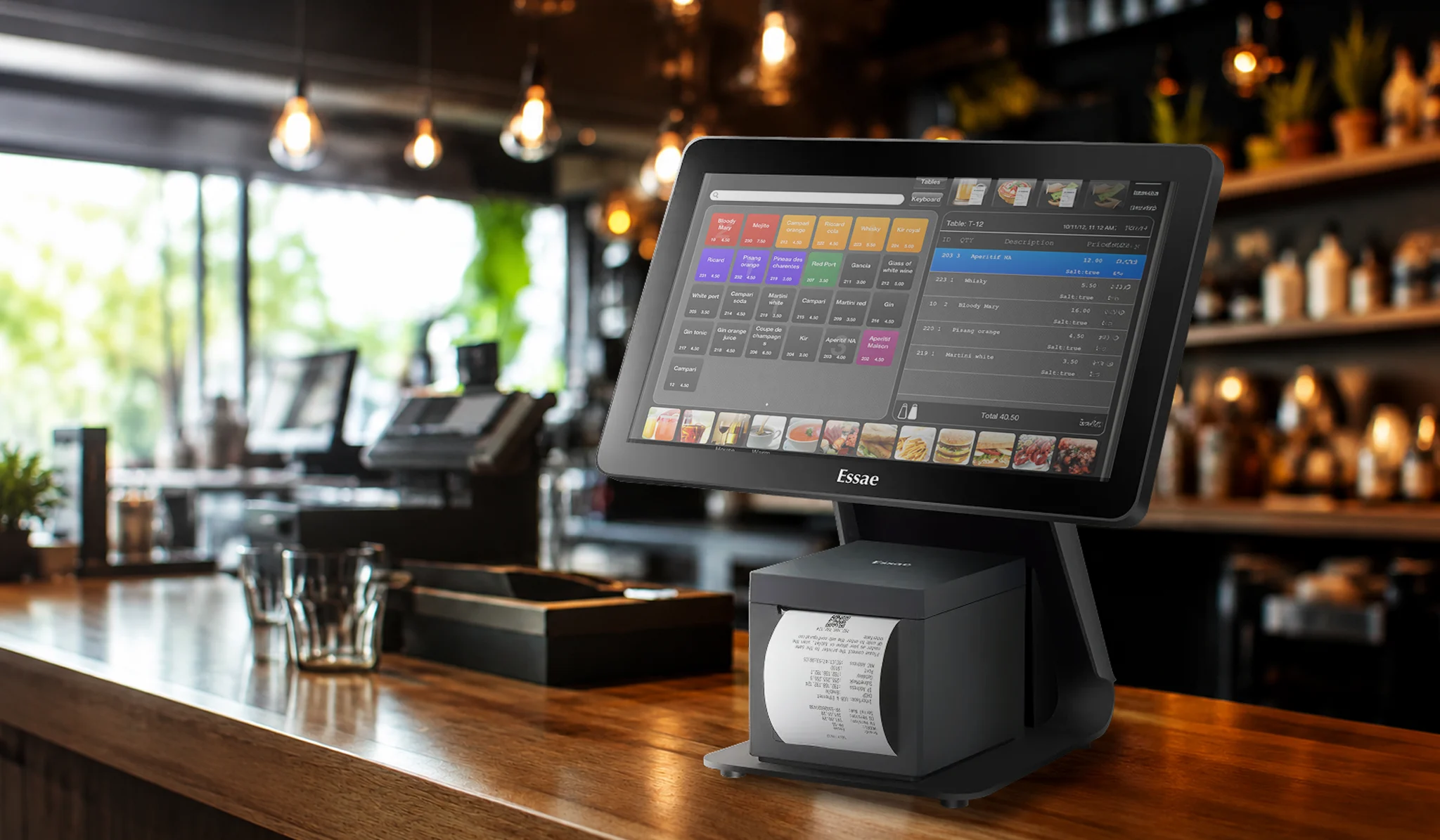
Modern POS systems are more than just software, they are integrated solutions where smart software meets reliable hardware to drive business efficiency. Software handles billing, inventory management, reporting, and analytics, but its true potential depends on the devices supporting it, including touchscreens, barcode scanners, printers, and processors. Strong hardware reduces errors and enhances the user experience by delivering speed, accuracy, and smooth operation.
Choosing the right POS system is about more than technology; it’s about reliability, efficiency, and scalability. Essae’s POS solutions combine advanced software features with durable, high quality hardware, helping businesses streamline operations, maintain accuracy, and grow confidently. In this blog, we explore key features and their hardware dependencies, showing how the right setup enhances performance and operational success.
How POS software and hardware work together
Every software feature relies on hardware performance to deliver real results. From fast billing to precise inventory tracking, hardware like touchscreens, barcode scanners, printers, and processors offer smooth and accurate operations.
The points below highlight key software capabilities and the hardware components that power them, showing how the right combination improves efficiency, reliability, and overall business performance.
1. Automated accuracy: Precision at every transaction
Consistent and precise billing begins with automated accuracy, reducing mistakes and boosting efficiency. A POS eliminates manual mistakes by calculating totals, applying discounts, and updating records instantly. Supported by durable touchscreens and high quality receipt printers, every transaction is recorded with clarity and speed. This combination makes checkout simple for both employees and customers while reducing errors that can cost time and money. The result is smoother operations, faster service, and a stronger sense of trust at the counter.
2. Real time inventory control: Staying ahead of stock
Inventory management becomes seamless when software and hardware work hand in hand. A POS updates stock levels the moment items are scanned or sold, providing real time visibility. Integrated barcode scanners and RFID readers feed accurate data into the system, minimizing discrepancies and preventing losses. High quality hardware guarantees rapid scanning during busy times, keeping inventory accurate and shelves full. This tight integration helps businesses avoid stockouts, cut down on waste, and maintain a consistent supply chain flow.
3. Faster checkout: Speed meets reliability
Customer experience often depends on how quickly the checkout process runs.POS software supports automatic calculations, quick billing, and product lookups. On the hardware side, high speed processors, responsive touch displays, and efficient receipt printers accelerate each step. Together, they keep queues short and service uninterrupted, even during rush hours. The combination of speed and reliability improves throughput, increases staff productivity, and leaves customers with a positive impression that encourages repeat visits.
4. GST compliant invoicing: Seamless tax management
Modern POS solutions simplify tax compliance by generating GST ready invoices with accurate calculations. The software applies tax rules automatically, while compatible printers and display units deliver invoices instantly. This not only saves staff from manual errors but also strengthens transparency for customers. Efficient hardware ensures consistent and uninterrupted invoice generation, even under heavy workloads. By adopting a system designed for compliance, businesses maintain legal accuracy, streamline accounting, and build greater credibility with customers and regulators alike.
5. Smart reporting: Analytics powered by hardware
Data driven decisions rely on smart reporting features within a POS. Software compiles sales reports, performance analytics, and customer insights, but the reliability of this function rests on powerful hardware. Fast processors, SSDs, and CPUs handle large datasets without delays, while secure storage keeps information protected.The accuracy and speed of reporting are directly impacted by hardware performance. With this combination, managers gain actionable insights faster, respond to trends in real time, and make confident, growth focused decisions.
6. Multi counter and branch management: Connected ecosystems
Managing multiple counters or branches requires a POS ecosystem that keeps everything connected. Software centralizes data, enabling seamless oversight across locations. Hardware like networked terminals, cloud ready devices, and centralized servers supports this integration, assuring smooth data flow. Together, they allow owners to monitor sales, inventory, and performance across all outlets in one system. This scalability simplifies operations, strengthens control, and makes expansion easier without disrupting existing workflows.
7. Device integration: Expanding hardware capabilities
Retail environments often need more than just billing functions. A POS modifies by connecting with devices like card readers, barcode scanners, and weighing scales. Hardware with versatile I/O ports and compatible drivers supports these extensions, allowing the system to expand as business needs grow. This flexibility reduces the need for separate systems and simplifies day to day tasks. By building a modular setup, businesses gain adaptability, making their POS a central hub for all operations.
8. Reliable hardware and support: The backbone of POS systems
Software efficiency is only as strong as the hardware supporting it. POS terminals, printers, and accessories must be durable enough to handle daily workloads without frequent breakdowns. Just as important is local service support, which minimizes downtime and keeps operations moving. A reliable setup delivers consistency, reducing disruptions that could frustrate staff or customers. Businesses benefit from higher trust in their systems, smoother continuity, and a stronger return on their investment.
9. Scalable architecture: Future proof your POS
Growth requires systems that can expand without losing performance. POS software is designed to scale across new counters, mobile units, or even online integrations. Modular hardware setups with flexible I/O ports and peripheral connectivity make that scalability practical. Businesses can add new devices, link branches, or upgrade capacity as demand grows. This future proof design protects long term investments and allows retailers to adapt quickly to new opportunities without costly replacements.
Conclusion
POS systems are most effective when software intelligence is matched by durable hardware performance. When these elements work together, businesses gain accuracy, speed, and reliability across every operation. Selecting a system that balances intelligent features with versatile devices provides both efficiency and long term adaptability. Before making a purchase, always review detailed product specifications in the catalog to choose the right fit for your business needs.
At Essae, we offer POS solutions combining advanced software features with reliable hardware, helping businesses streamline operations and boost performance confidently.
Explore Essae’s Teraoka POS catalog today to discover solutions built for speed, accuracy, and reliability. Equip your business with technology designed to grow and adapt seamlessly.


