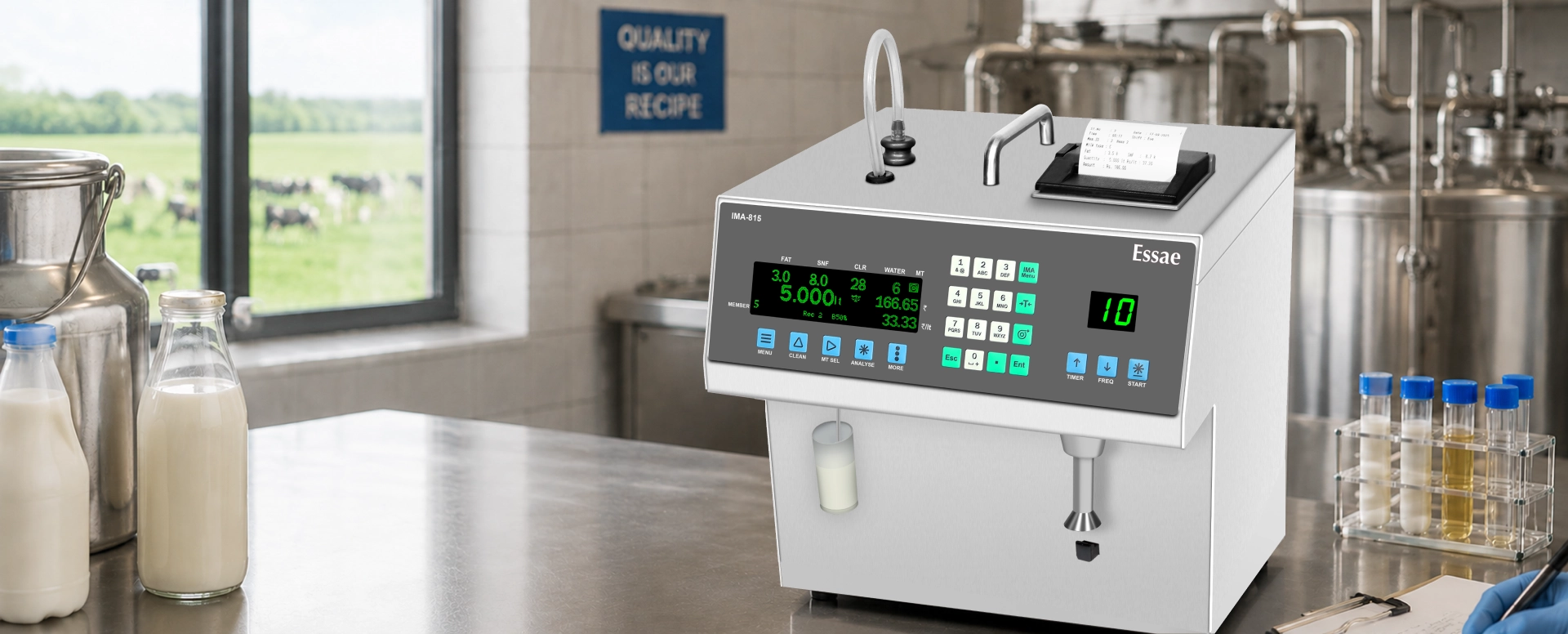
These days, consumers are more aware of milk and related products, which has raised the quality expectation towards dairy businesses. Companies have become strict with compliance and safety standards to effectively build and maintain their profitability. This is where milk testing machines come in.
With innovative milk testing technologies, the results are more accurate, fast, and reliable. Cooperatives, dairy brands, and farmers are found to utilize these to build quality across the supply chain.
In this blog, we explore the significance of
milk testing machines across the milk industry and whether upgrading to such solutions is a smart long term investment.
Benefits of milk testing machines in the milk industry
Let’s have a look at the various ways in which milk testing machines are delivering value across the dairy industry:
Purity for consumer safety
Food safety is a top priority in the dairy sector, where there is no compromise on the quality of milk. Even the slightest contamination or left unaddressed, can trigger major health issues.
The implementation of a modern milk testing machine detects any additional substances present in the milk, such as glucose, urea, starch, etc.
Fat and SNF analysis for pricing
In certain regions, milk is priced on fat percentage and SNF, which is solids non fat. However, manual testing for these purposes can often result in errors and dissatisfaction.
Milk analyzers or testing machines, on the other hand, provide correct and consistent results, which help maintain transparency. This also means fair payments for farmers, supplier loyalty, and stronger customer relationships.
Real time data for better decision making
Quality check managers and procurement teams can access results and related data instantly, as many advanced milk testing machines are connected to software systems.
With these real time insights, companies can easily monitor supplier performance, optimize sourcing strategies, maintain quality supply, and detect seasonal purity fluctuations.
Speed and operational efficiency
As milk is collected multiple times a day, any delays or when left overlooked can make it unfit for consumption. Traditional lab based testing usually takes time, and the results are not always reliable as well.
The milk testing machine or analyser comes with automation and therefore speeds up the data generation and reduces wait times for farmers. It supports quicker quality grading and ensures that the milk moves through the supply chain faster.
Automation for better workflow
When it comes to quality critical workflows, human errors are unavoidable and risky. Milk analysers address this concern via automation and help standardize testing processes.
It helps minimize miscalculations and improve result accuracy. This leads to reduced staffing requirements, followed by improved workflow and less dependency.
Profitability and long term sustainability
Modern milk testing systems effectively help cut down on operational costs and improve results quality. This is essential to get rid of damaged or unfit batches and execute better control over processing inputs.
Thus, you can expect increased yield, consistent brand quality, and reduced wastage, all of which contribute to smarter profitability for your business.
Traceability and compliance
As industry regulations get more stringent, traceability becomes more important than ever. Digital milk testing machines help maintain detailed records of quality parameters such as test results, collection timing, batch origin, purity, and so on.
Dairy businesses can therefore easily stick to food safety guidelines, track milk journey from farming to processing, and deliver documentation during audits. This strengthens brand reputation in domestic and export markets.
Essae Milk analyser is one of the leading milk testing machines with state of the art manufacturing and advanced technology. Designed to support high end milk quality assessment, each of our products addresses various aspects of milk analysis to generate data driven insights to make informed decisions and achieve maximum efficiency.
Conclusion
It is a well known fact that milk gets easily contaminated and is often transported long distances before reaching the final location. Its perishable nature calls for strict practice of safety, quality, and compliance standards. Thus, the dairy sector is rapidly turning to the implementation of advanced milk testing machines.
These milk analysers are proven to support accuracy, transparency, and compliance at every step of the milk journey. Dairy businesses can now successfully detect adulterants, analyse milk components, and maintain quality, all without any delays, hassles, or errors.